
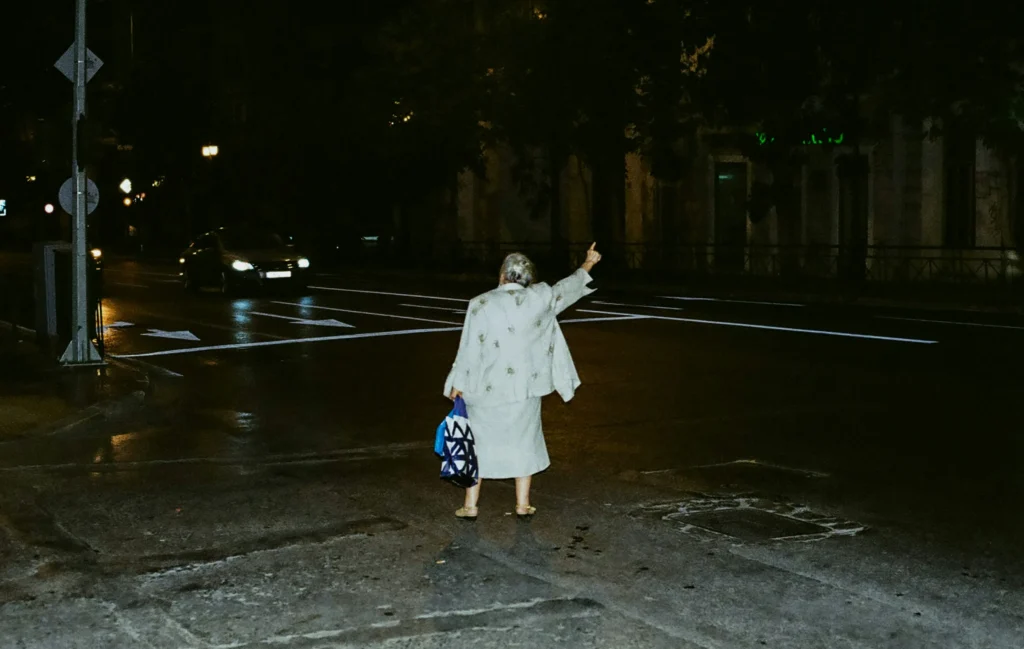
When I was a little girl the idea of not hitchhiking was never imposed upon me intensely. I knew it was something I must not do and that it was dangerous for me. But this knowledge was almost instinctive. It was a generally accepted reality in the society, and was never questioned, or thought about deeply.
The fact that hitchhiking is dangerous was so compelling that such option never even existed in my mind. I remember only once somebody mentioning it as an option. I was out of town with a group of friends. Our bus did not show up, so somebody suggested hitchhiking back. The person put it more so like a joke, rather than a suggestion. I can’t recall what my thoughts on the matter were or what did the other guys say. But I think we merely brushed off the option.
I Met Her in Mashhad
I encountered Sepide when I was travelling through Iran. My host in Mashhad had a little party at home, and she was one of the guests.
I remember thinking how beautiful and how much out of place she was in that country. Her attire and the general appearance looked far from Iranian. Hijab looked very strange on her, something that clearly did not belong in that picture.
We talked for two hours or so about my journey and my experiences, for she had numerous questions to ask. But it was clear to me that she was not asking out of pure curiosity. Her questions were more purposeful and thought through. She was also seemingly more perceptive than many other people of the things I was telling her.
She told me that she could not stand living in Iran, that she felt trapped there. And that it was her dream to travel like me. ‘But I am broke’, – she said. A very weak passport and no knowledge of English in her mind also reduced her prospects of accomplishing much in that regard.
That evening I decided to write and guide of sorts which I personalized specifically for her. In that guide I explained to her various ways how she could manage to travel on very little, or without any money if it was necessary. And few other pieces of information, web-sites and applications she could use.
In a few months’ time I received a letter from her, in which she stated that she had begun travelling on her own.
The General Pointers of this Guide
In my years of travels I have hardly been in an unfortunate, dangerous and scary situation. People oftentimes say that I am lucky that I meet only good people. What they do not realize is that my reasonably safe journey is predominantly of my own making. From the early on my approach to travelling was different. I perceived my safety and well-being as my own personal responsibility.
In other words, if something unpleasant was to happen to me I would be the one to blame for it. Such approach enabled me to develop numerous habits, behaviours and mechanisms that served me well over the years.
With time I developed additional motivation to work on my conduct. I did not want to depend on other men saving me. I wanted to become a woman who can successfully enough navigate this men’s world and extract all the benefits of her sex. At times I still experience need to be assisted in though situations. But after four and a half years I can say that I am certainly closer to being freer from these limitations than I ever was before.
In this guide I would like to share the general tips and suggestions to increasing one’s odds to safe and enjoyable travels.
Pack as Few Items in Your Backpack as Possible
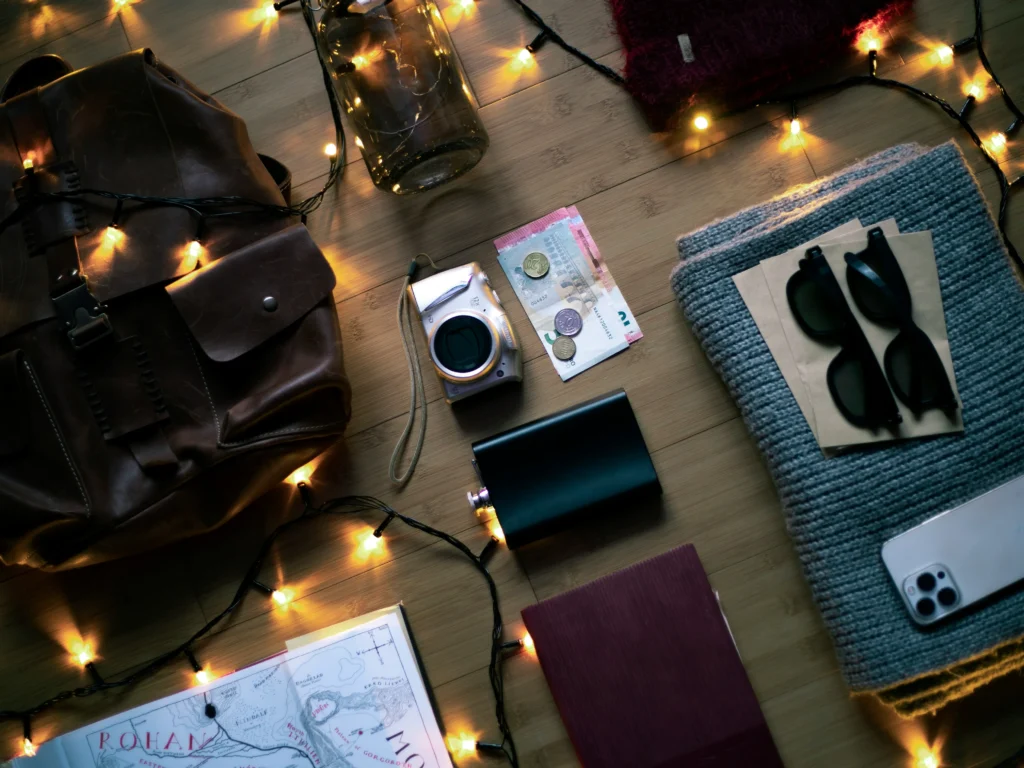
At first the connection might not seem straightforward. But it does matter how much stuff you have with you and how heavy your backpack is. For the most part of my journey I used two backpacks. A bigger one contained all my clothes, hygiene items, and so on. In a smaller one I had a laptop that I took with me from Georgia, all the cables, passport, and other little items. Smaller backpack was always of greater importance, so I would never leave it unattended.
I was always mentally prepared to leave the bigger one behind, if I had to, say, run away from my ride. But, of course, it is something I would do only in an outstanding case scenario.
I have been to a couple or so situations when I wanted to leave, but my backpack was in the luggage compartment. Which complicated the matters.
On the other hand, once when I was hitchhiking in Serbia I was picked up by an Albanian man who desired me so much that his member was restless throughout the entire next hour or so. I had only one small backpack with me, for I was just going back to Belgrade where I had left most of my belongings.
The entire ride he could not stop touching me. He also wanted me to touch his erect penis. For the first ever such encounter I think I dealt with him reasonably well. I understood one important thing that time – as long as the car is moving, the driver cannot do much for he understand the dangers involved.
But then he decided to pull over at the parking lot on the highway. Once he stopped, I jumped out of the car with my backpack in my hands. If I had another backpack in the luggage compartment, it would be more difficult to get out of there.
What To Carry
It almost does not matter how long your trip is. A few t-shirts, one pair of pants and/or leggings, one pair of shorts and/or a skirt, one sweater or a fleece, underwear and socks are perfectly sufficient. This is more or less the amount of clothes I carry. And I don’t have a home, mind you.
There is generally no need for shampoo, conditioner or shower gel either, but that depends on personal preferences. Only some items of personal hygiene, wet napkins, creams, and so on. That said my hygiene bag is the heaviest item in my backpack.
The lighter the backpack, easier and quicker it also is to move around. My backpack at first weighed about 13 kilograms and I had a small one of about 6 kilograms in front of me. I was walking like a pregnant elephant. In the heat, under the sun the movement was particularly complicated.
In short: Pack your backpack in a way that it is as light as possible. Aim to have only one bag. Do not carry too much clothes, as the odds are they won’t be needed. Not only this approach improves your mobility, it also accounts for your safety.
Do NOT Blindly Depend on Your Phone
For about a year out of four and half I have travelled without a phone. Generally the way I would handle the navigation is that I would look on the map in advance, write down on the piece of paper names of cities, towns, and draw a map if it was necessary. Later on in the day, if I needed to have a quick look on the map borrowing a phone from my ride, for example, was not a problem. Virtually everybody has got one.
Having no phone was just as liberating of an idea as having no money. It is even less likely to get lost in such case then when having a phone and navigation on. Because observing the surroundings and memorizing them becomes imperative and our brains function differently.
Also, another problem with having a phone is that it creates a false sense of safety. Of course, at times having a possibility of making that emergency call could save one’s life. But before anybody shows up to save you anything can happen. And this the period of waiting is the time when you are left to your own devices and your ability to get yourself out of there is tested.

Think about it. What if the phone got stolen? Or broke down? What if it fell on the ground and broke? The battery simply died?
Knowing your route is not only necessary for the general information, but it also accounts for your own safety. In case if your ride turned off the main route without openly stating it, knowing the way could be crucial to your survival.
In short: Be aware of your surroundings. Study the map and pay attention to where you are. Focus on absorbing the immediate information around you.
Make Sure to Have a Safe Abode by the Time It Is Dark
Hitchhiking in the dark comes with number of problems. In the dark the visibility is lower, thus some drivers simply might not see you, or avoid stopping for the sake of their own safety. It does as well become a little tricky and might take longer waiting time than during the day.
Not only is it important for the driver to see you in order to stop, it is also important for you to be able to see the driver well enough, so you know whose car are you getting into. The first impression is of the utmost importance. If there is anything at all that ticks you off about the person, it is always better to pass on the option.
Also, in my case, since I am looking for hosts as well, ending up at the final destination before dawn is always preferable. In some countries where sketchy things do happen at night, I always make sure that I am indoors by sunset.
If you can’t avoid hitchhiking after the sunset, find a source of artificial light and wait or your ride.
In Short: Avoid being outside after dark, at least in the beginning before gaining more experiences and knowledge.
Always Pay Attention to What Is the Person Saying
This happened in Turkey. I was together with my companion. As usual, the person asked us standard questions. He asked where do we sleep at night and we explained that we stay with locals. There was clearly something about his general demeanour that I had missed, which my partner did not.
He invited us to stay with him. My immediate reaction was positive. But my companion said quickly that we would like to travel further, and that we had to decline his offer. He responded that it was pity that we could not stay and added that there would be unlimited alcohol.
Later on the guy commented something about my breasts and how my shirt accentuated them. Of course, then the picture became clear. He wanted us to get tipsy, or drunk, so then he could fuck me.
My host in France has a very similar experience while hitchhiking through Turkey.
Another experience in North Macedonia
I was on my way to Greece. This man picked me up near Albanian border and was driving to the last town before the Greek border. We had spent about six hours on our way to that town, most of this time we talked.
When we were approaching the town, he missed the last turn and continued driving straight. He never explained why. I did wonder where could he be driving, but I thought to myself that I would just wait and see in a bit what was going on.
He drove to a small dark village where not a single person was to be seen.
‘Aren’t you going to ask me where am I taking you?’ – He finally broke the silence.
‘I am curious, sure’, – I responded.
‘Aren’t you afraid that I am going to drive you somewhere else and cut you up in pieces?’ – he laughed.
‘Nah! I think it would too much of a bother’, – I said.
He then explained that his van, was too big to drive it in the city. We had to switch to another vehicle. We drove to that village because his smaller van was parked there.
This man ultimately treated me to a dinner, drove to a hotel and gave me 20 euros, so I could spend the night there.
The point is that when it comes to hitchhiking people mostly stop in order to help, and they rarely have reasons to lie about their lives. Therefore, listening to another person will help to draw adequate conclusions about their actions. This behaviour could either save you in a very dangerous situation, or help you avoid creating unnecessary mess.
Because most of the times if a person stopped to pick you up, they most likely just want to help.
In short: Paying attention to what the person says and what kind of ideas they convey is critical in ensuring one’s mental and physical well-being.
Assume That Almost Every Person You Meet Is Out There to Get You
I said this countless amount of time during my journey – the world is not as dangerous as people think it is. Most of the fears and anxiety that we experience are deeply rooted within us. Therefore, it is incredibly difficult to reason with these fears if one has no primary experience to relate to.
For example, when I was travelling to South America I did experience some anxiety over possible troubles I could encounter there. But then I thought about Iran and Afghanistan. These countries are arguably more dangerous for a woman to travel in. And I managed myself there reasonably well. These memories and thoughts helped me to relax and reason with my fear.
But if the world is not as dangerous, why is it necessary to assume that it is?
Human nature is the answer.
Just as predictable humans can be, in the same way unwanted things still can happen.
Assuming that everyone is out there to get you does not suggest being paranoid. On the contrary, it implies imagining all sorts of worst case scenarios, so then one builds sturdy and durable walls around oneself in order to protect oneself from such cases.
In practical terms it means always being aware of one’s own surroundings; observing people around oneself; being firm in one’s own decisions, but still gentle and unprovoking with others; think of the ways how to exploit societal weaknesses.
Some examples of these behaviours are: paying attention to the plate number of the car you get into; keeping your belongings close to yourself; wearing a ring or a hygiene pad could bring some peace of mind to some women in Muslim countries; not allow a person to push one’s own agenda forward if it conflicts with your own.
In all my four and a half years of travelling/hitchhiking around I have not experienced a single situation when I would think that I was in a big trouble. These behaviours and mechanisms are the main reason why my journey is so uneventful in that regard.
In short: Adopting a stance that the odds are against you by default should enable you to think of the ways how to increase them. And if you implement new behaviours successfully enough, in reality your odds will increase significantly higher.
Thinking in Terms of Odds
There is no such a thing as absolute safety or certainty. The favourite phrase of most human beings ‘you never know’ does make sense in this context, because, indeed, there is never a 100% security. And this is when thinking in terms of odds becomes quite handy.
What do you think are the odds of a brick falling on your head? Or getting into a car crash? What could be the odds of a man sexually abusing a woman in Scandinavian countries versus in Muslim countries?
Humans are geared to think in such terms, and there is nothing new about this idea. But it is a one thing to do it in unconscious or semi-conscious way. And another to adopt it as a strategy, which will enable you to attract the experiences you would like to have and repel the ones you do not wish to. If adopted successfully enough, it can be a powerful weapon, with a use of which one is able to bend the world to one’s own needs.
What Does it Mean in Practice
We define the odds based on our experience, understanding of various situations and basic facts and statistics. For example, I would say that the odds of getting into a car crash in Albania are at the very least double of the same happening in Denmark. I say that based on my experience, of course. In Albania if the speed limit is 60 km/h, they will drive 160 km/h. While in Denmark people strictly follow the signs.
I would say that the odds of a Scandinavian man sexually abusing a woman are less than 5%, while in a Muslim country the odds could be above 30%. The odds of a Scandinavian man who is older than 70 sexually abusing a woman are higher than a younger man.
In my case, my understanding of separate individuals has improved over the years to a point that I can more or less predict some of their behaviours. On some occasions I have gotten into a car, knowing that the person is going to say or do something (say, touch me). But I still got in there, because I got an impression that if I was to express disinterest towards him, he would not insist. To me that makes him an alright person to have a ride with.
If Shit Hit the Fan

Thinking in such a way enables a person to reason with one’s own fears, and act more rationally rather than emotionally. This difference in one’s conduct could be crucial to ensure one’s survival. But, naturally, odds are just odds. And sometimes severe underdogs win, too.
So, the question what to do in cases when something was missed?
To have an answer to this question, there must be a good enough understanding of man’s perspective. Take Iran for example. In that country it does not matter whether you are fully covered or no; does not matter how pretty you are; it is of no consequence whether you did or said something to provoke his desire towards you. If you are a woman and your body temperature is 36.6o C you passed the test.
The most straightforward solution in case of encountering such a man is to get out of there as soon as possible. Most of the times they will not bother with you much and let you go if you request them to stop. But in case they refuse, one way to go about it is to become as boring and/or potentially as disgusting as possible.
Think about it, he desires you. In that moment in time you are the most beautiful woman to him, perhaps an angel who came down from heaven specifically for him. How would he feel if you were to pee yourself? Or vomit all over? Or if you have periods, showed him some blood?
The aim in such a situation would be to arouse certain emotions in him, in order to make him want to get rid of you. Aversion and disgust would one of those emotions.
Summary
The mistake that most people make when travelling to another country is that they wonder how safe that country is. They look up information, check the statistics, and so on. The problem with such approach is that when concentrating on this particular aspect, essentially, what a traveller does it that he or she puts one’s safety and well-being in the hands of a bunch of strangers who inhabit that country.
Instead it is far more reliable of an approach to think how one can improve one’s own behaviours in order to prevent anything unwanted happening. In that case it will not matter as much how safe or dangerous the country can be.